The 8-Week Program Chair Pilates
Real Pilates — the deep core, the long spine, the steady hips and the balance work — done entirely from a sturdy kitchen chair. No getting down to the floor, no kneeling, no lying on your back. Designed by Sophie Mercer, a PMA-certified instructor with 4,000+ teaching hours, for anyone the mat has quietly left behind: stiff knees, a cranky back, a bigger body, a wobbly sense of balance, or simply a floor that feels a very long way down.

The Mat Was Never the Point — the Movement Was
Most Pilates assumes you can get down onto the floor, kneel on it, roll around on it and get back up again without a second thought. If you can't — or if you can, but it costs you — every class, video and PDF quietly tells you this isn't for you. So you stop. And the stiffness, the weakening legs and the wobble on uneven ground carry on exactly as before.
Getting down to a mat is an event, and getting back up is the part you dread — so you avoid anything that needs the floor
Your knees, hips or back complain when you kneel or lie flat, and the 'gentle beginner' classes still ask you to do exactly that
Standing up from a low chair, the car seat or the toilet has started to need a push from your arms
You sit for most of the day and your back, hips and shoulders have set like concrete — the first ten minutes of every morning are stiff
You've stopped trusting your balance: the kerb, the shower, the stairs without a rail
Online chair workouts are either so easy they do nothing, or they jump about with no structure, no progression and no idea who's watching
Six Targeted Approaches to Lasting Relief
Not One Exercise on the Floor
All 32 exercises are seated or standing with a hand on the chair. If you can sit in a dining chair and stand up behind it, you can do every session in this program.
Core & Posture from a Seat
Seated pelvic rocks, roll-downs, twists and side bends train the deep abdominals and spinal mobility — the work that makes you taller and takes the ache out of sitting.
Leg Strength That Changes Your Day
Sit-to-stand, supported squats, heel raises and hip hinges build the thigh and glute strength that gets you out of chairs, cars and baths — the single most useful strength there is.
Balance with a Safety Net
Single-leg, tandem and reaching balance holds progress from two hands on the chair to fingertips to hovering — always with support within reach.
Kind to Knees, Hips, Backs and Bones
No kneeling, no loaded spinal flexion, no impact, no deep twisting. Options for arthritis, joint replacements, osteoporosis and bigger bodies on every card.
A Real Progression, Not a Random Video
Four phases over 8 weeks, each with two session plans and a progress rule, so every week asks a little more and you can see exactly how far you've come.
The Mercer Biomechanical Framework
This isn't a random collection of chair exercises. Every protocol is built on a biomechanical model developed across 4,000+ hours of clinical Pilates practice — here adapted so a sturdy chair replaces the mat entirely.
Settle & Connect
Entirely seated. Breath, pelvic rocks, spinal mobility, marching and the first sit-to-stands — learning to find and hold a tall, stable centre in the chair.
Strengthen the Centre
Seated strength for the thighs, hips and abdominals, plus the first standing work with both hands on the chair — heel raises and single-leg holds.
Stand Up Stronger
Chair-supported squats, hip hinges, side leg lifts and band rows — the functional strength that gets you out of a car, up a step and off a low sofa.
Move with Confidence
Sit-to-stand with no hands, tandem balance, reaching holds and a seated maintenance routine you will keep for life.
Your Complete Recovery Toolkit
- Complete 8-week progressive chair Pilates program (4 phases, 2 session plans each)
- 32 exercises with detailed instructions and photo demonstrations — all seated or chair-supported
- Seated baseline self-assessment — sit-to-stand count, balance seconds and a posture check to track your progress
- Weekly progression milestones and progress rules for every phase
- Condition modifications on every card — arthritis, knee and hip replacements, osteoporosis, bigger bodies
- Printable workout logs for every week
- BONUS: 5-minute seated morning routine for stiff mornings
- BONUS: Chair setup & safety guide — the right chair, the right height, and how to use the support without leaning on it
Inside the Protocol
A structured, clinical-grade document — not a random collection of exercises. Here's what's waiting for you inside.
55 pages of structured, clinical-grade programming. Get instant access →
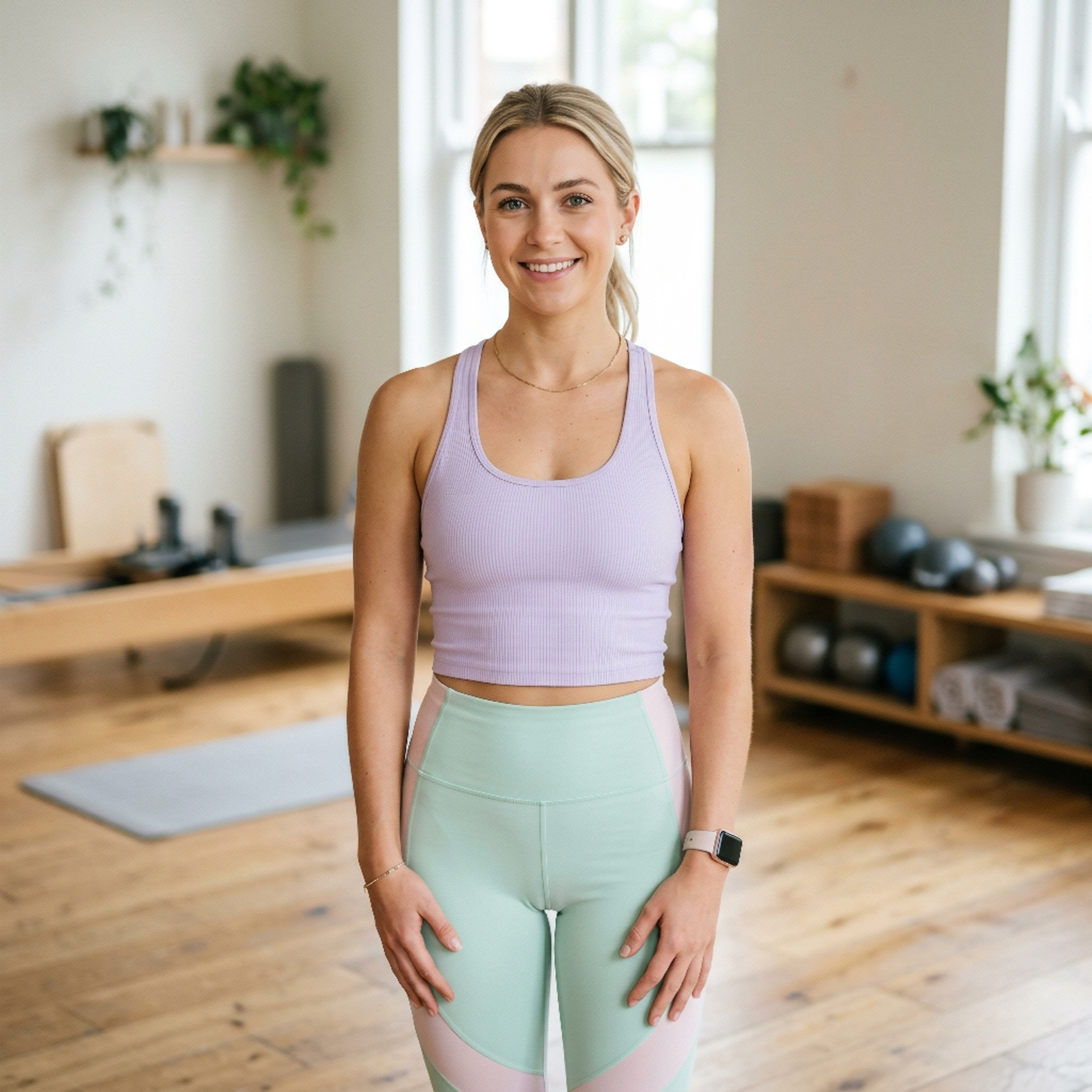
Sophie Mercer
Clinical Pilates Instructor
"I don't believe in generic programs. Every condition has specific needs, and every person deserves programming that respects that."
Sophie has spent over 15 years working one-on-one with clients dealing with chronic pain, post-surgical recovery, and movement dysfunction. With more than 4,000 hours of hands-on teaching, she has developed a deep understanding of how the body compensates, adapts, and recovers. Every Pilates Protocols program is built from this clinical experience: real progressions that work, tested across hundreds of real clients.
Certifications
Specialisations
Progressive, Not Random
Every week builds on the last. No guesswork, no random exercises — structured recovery.
Clinically Informed
Programs designed from real teaching experience with real conditions, not textbook theory.
Built for Real People
Modifications for every level. You start where you are, not where someone else thinks you should be.
What Clients Are Saying
Random YouTube Videos vs. A Real Program
Without This Program
- Classes and videos that always end up on the floor — so you skip them or struggle through
- Chair workouts with no progression: the same easy moves forever, with nothing to show for it
- Legs that keep weakening while you wait for a routine that fits
- Avoiding the kerb, the shower and the stairs because you don't trust your balance
- $60–100 per class for a 'gentle' session that still assumes a mat
- No idea whether you're actually improving
- Studio classes in Singapore at S$45–60 each — S$890+ for a 20-class pack
- Private physio at £50–75 a session, or reformer classes at £25–45 each
- Physio consults at A$90–130, or reformer classes at A$35–60 each
With Pilates Protocols
- 32 exercises, every one seated or chair-supported — nothing on the floor
- 4 phases over 8 weeks with two session plans each and clear progress rules
- Sit-to-stand, supported squats and hip hinges that rebuild real-world leg strength
- Balance holds that progress from two hands to fingertips to hovering
- One-time $27, print it or keep it on your tablet forever
- A seated self-assessment at weeks 0, 4 and 8 so the progress is in numbers
Sophie built her strength on Pilates alone — so can you.
The posture, the control, the pain-free movement Sophie teaches were all built on the mat. No weights room. No punishing workouts. No surgery. Just the right movements, in the right order, done consistently — which is exactly what this protocol gives you.
You don't need to be younger, fitter, or braver. You need a method that works with your body — at 50, 65, or 75 — instead of against it. Women across every one of those decades are following these exact sequences at home, in their own time, and getting their lives back.
Start today — $27 →Your Investment in Lasting Relief
Get the complete library — all 40 protocols
This programme is $27 on its own. If you're likely to reach for more than one — a different condition, a sport, a life stage — the whole library costs less than three single programmes, with lifetime access and every future protocol free.
- All 40 clinical protocols, every category
- Quick-Start cheat sheets + direct email access to Sophie
- Every future protocol added — free, forever
Got Questions? We've Got Answers
Is chair Pilates really Pilates, or just gentle chair exercise?
It is Pilates. The principles — breath, a neutral spine, a deep core brace, slow precise movement from a stable centre — are identical; only the base changes. The seated cards train the same deep abdominals, spinal mobility and shoulder control as the mat versions, and the chair-supported standing cards add leg strength and balance work that mat Pilates doesn't include. What you lose is floor-based loading (planks, side-lying leg series). What you gain is a program you will actually do.
Is there genuinely nothing on the floor?
Nothing. All 32 exercises are performed sitting on a sturdy chair or standing behind it with your hands on its back. You never kneel, lie down or get up from the floor. If one day you want to add mat work, the Over-60 program is the natural next step — but you don't need it to get full value from this one.
I have arthritis / a knee or hip replacement / osteoporosis. Is this safe?
The program was built with those bodies in mind. There is no kneeling, no impact, no loaded spinal flexion and no deep twisting, and every card carries a condition note: smaller ranges for arthritic joints, the surgeon's precautions respected for replacements, and the osteoporosis-safe version (lengthening rather than rounding) for every spinal exercise. As always, show the program to your doctor or physiotherapist if you are under care, and follow their advice first.
I'm not a senior — I'm 45 and sit at a desk all day. Is this for me?
Yes. A large share of the people who choose chair-based programs are under 60: desk workers, people with bigger bodies who find the mat uncomfortable, people managing a chronic condition, and carers who exercise alongside the person they look after. The seated phase doubles as a desk routine, and the standing phases will challenge anyone whose legs have been sitting all day.
What chair do I need, and do I need a band?
A sturdy dining or kitchen chair with no wheels and ideally no arms, high enough that your knees are level with or slightly below your hips. Put its back against a wall for the standing work. A light resistance band is optional for four of the exercises — a long towel or a tin of beans does the job if you'd rather not buy one. No mat, no reformer, nothing else.
How much time does it take?
Three sessions a week of about 20 minutes, alternating Routine A and Routine B, plus the 5-minute seated morning routine on the days you wake up stiff. On a bad day the morning routine counts as your session. Most people feel less stiff within two weeks; the sit-to-stand and balance numbers usually move noticeably by the week-4 re-test.
Everything People Ask Us (And AI) About Chair Pilates
Short, direct answers to the questions people search most often — with the evidence and protocol references behind each one.
Can Pilates help with chair pilates?
Yes. Clinical Pilates is one of the most evidence-supported conservative interventions for chair pilates. Peer-reviewed RCTs and clinical practice guidelines (including NICE, Cochrane, and condition-specific consensus statements) recommend it as a first-line non-pharmacological option.
The mechanism is well understood: Pilates restores the motor-control patterns, deep stabiliser function, and graded load tolerance that are typically deficient in chair pilates. Unlike generic exercise, clinical Pilates is dosed conservatively and progressed across phases, which is why it works for symptomatic populations who cannot tolerate harder modalities.
For a structured, condition-specific implementation, the The 8-Week Chair Pilates Program follows the Mercer Biomechanical Framework: decompression first, then stabilisation, then integration.
How long does Pilates take to help chair pilates?
Most people with chair pilates report meaningful change within 3–4 weeks of consistent practice (2–3 sessions per week). Substantial functional improvement typically takes 6–12 weeks, with maintenance benefits accruing beyond that. Published outcome data for structured programmes shows 0 floor exercises every move seated or chair-held.
Recovery timelines depend on severity, chronicity, age, and prior activity level. The first phase typically focuses on settle & connect — entirely seated. breath, pelvic rocks, spinal mobility, marching and the first sit-to-stands — learning to find and hold a tall, stable centre in the chair. Conservative dosing in the early weeks is what allows slower responders to progress without flare-ups.
The The 8-Week Chair Pilates Program is a 8 weeks structured progression with weekly milestones, so you can track whether you are responding on the typical curve.
Is Pilates safe for chair pilates?
Yes, when programmed appropriately. Pilates is included in mainstream clinical guidelines for chair pilates precisely because of its low-load, controlled-movement profile and its ease of individual modification. The risk profile is significantly lower than higher-intensity exercise or unsupervised stretching.
Anyone with acute injury, post-surgical recovery, or red-flag symptoms — numbness, loss of bladder or bowel control, severe night pain, unexplained weight loss — should be cleared by a clinician before starting any exercise programme.
The The 8-Week Chair Pilates Program is designed for all levels, including absolute beginners, and includes explicit modifications, contraindications, and red-flag guidance in every phase.
Can you do Pilates for chair pilates at home?
Yes. The majority of evidence-supported Pilates protocols for chair pilates are mat-based and require no reformer, no studio membership, and minimal equipment. A self-directed home programme is often the most realistic delivery model for people in pain or with limited time.
What matters more than location is structure: a defined progression, photo-demonstrated technique, and clear contraindications. Generic YouTube routines lack all three, which is why people often stall on relief.
The The 8-Week Chair Pilates Program is a downloadable 55-page PDF with 32 exercises, weekly schedules, progression milestones, and printable workout logs — runs on a mat plus chair and light resistance band (optional).
What Pilates exercises should you avoid with chair pilates?
The contraindicated exercises vary by condition, but the general principles are: avoid loaded end-range positions on irritated tissue, avoid movements that reliably reproduce your symptoms, and avoid progressing intensity faster than your tissues can adapt. For lumbar conditions this typically means caution with loaded flexion; for shoulder conditions, end-range overhead loading; for hip and knee conditions, deep loaded flexion in pain.
The right answer is not a blanket exercise blacklist — it is an evidence-aligned progression in which higher-risk movements are sequenced in late, in modified form, or omitted based on individual presentation.
The The 8-Week Chair Pilates Program includes an explicit "what to avoid" section per phase, aligned to the contraindications relevant to chair pilates (see clinical evidence library).
Pilates vs yoga for chair pilates — which is better?
For most musculoskeletal conditions including chair pilates, the evidence supports Pilates more strongly than yoga. Pilates is built around controlled progressive loading and motor-control retraining; many yoga styles rely on passive end-range stretching, which can aggravate sensitised tissue. Clinical guidelines including NICE NG59 for low back pain list Pilates explicitly as a first-line group-exercise modality.
Neither discipline is monolithic. A well-programmed therapeutic yoga class with an experienced teacher can also help, particularly for stress, sleep, and breath co-benefits. The key variable for chair pilates is condition-specific programming, not the discipline label.
The The 8-Week Chair Pilates Program is condition-specific by design, which is the variable that matters most regardless of which discipline you choose.
What is the best Pilates program for chair pilates?
The best Pilates programme for chair pilates is one that is (a) authored by a clinically-qualified instructor, (b) condition-specific rather than generic, (c) progressive across multiple phases rather than a single static routine, and (d) includes explicit contraindications and modifications. Most free online routines fail on at least two of these criteria, which is why self-directed recovery often stalls.
Structure beats price for self-directed recovery. A free 20-minute YouTube video repeated indefinitely cannot produce graded adaptation; a structured multi-week progression can.
The The 8-Week Chair Pilates Program is a 8 weeks progression by Sophie Mercer, PMA-CPT (4,000+ teaching hours), built on the Mercer Biomechanical Framework.
Strong, Steady and Tall — Without Ever Getting Down on the Floor
Picture standing up from a chair without thinking about it. Reaching the top shelf, turning in the kitchen, stepping off a kerb — all of it unremarkable again. You don't need a mat, a studio or a younger body to get there. You need a sturdy chair, twenty minutes three times a week, and a program that respects where you're starting from and asks a little more of you every week. This is that program — the same clinical structure as every Mercer protocol, built so that the floor is never between you and the work.
Get Instant Access — $27Pilates for Chair Pilates — head-to-head with the alternatives
Evidence-based comparisons of Pilates against the four most common alternatives people consider for chair pilates. Each page lays out where Pilates is the stronger choice, where the alternative is, and what the published research actually shows.