The 10-Week Pilates Program for Triathletes
Train harder, recover faster, and stop losing your season to the same nagging injuries. Designed by Sophie Mercer, a PMA-certified instructor with 4,000+ teaching hours, this program is built to bulletproof your body across swim, bike, and run, sharpen your transitions, and give you the core resilience to hold form from the gun to the finish line.

Three Disciplines Are Creating One Broken Body
Triathlon demands three contradictory things from one body: swim with mobile shoulders, cycle in deep hip flexion, and run tall and upright — often in the same day. You put in the hours, you love the sport, but you're always one high-volume block away from the niggle that derails everything. That cumulative load creates imbalances single-sport athletes never have to fight.
You break down right when the training is finally clicking — always the same maddening cycle: build, break, restart
Your hip flexors are cemented shut from cycling, robbing your run stride of power and lighting up your lower back
Shoulder fatigue from the pool compounds with your cycling posture into chronic upper back and neck tension
Your T1 and T2 feel clumsy and slow — your body can't switch positions cleanly, and you're leaking time you trained hard to gain
Your core gives out in the final third of every discipline — your stroke falls apart, your pelvis rocks on the bike, your run form collapses
You grind through gym strength work, but it never touches the cross-discipline demands triathlon actually places on you
Six Targeted Approaches to Lasting Relief
Cross-Discipline Imbalance Correction
Address the specific muscle imbalances that swimming, cycling, and running create together — the patterns that single-sport programs miss entirely.
Hip Flexor Liberation
Systematic release and lengthening of the hip flexors that cycling locks down — restoring the hip extension your running stride desperately needs.
Shoulder Resilience
Scapular stability and rotator cuff endurance work that protects your shoulders across high-volume swim training and cycling posture.
Transition Mobility
Specific exercises that improve your body's ability to switch between swim, bike, and run positions — smoother T1 and T2, faster race times.
Fatigue-Proof Core
Deep core endurance training that maintains your swim stroke, pelvic stability on the bike, and running form when everything else is failing.
Foam Roller Recovery Protocol
Discipline-specific foam rolling sequences for post-swim, post-bike, and post-run — plus a combined race-day recovery protocol.
The Mercer Biomechanical Framework
This isn't a random collection of exercises. Every protocol is built on a proprietary biomechanical model developed across 4,000+ hours of clinical Pilates practice.
Screen & Correct
Identify your cross-discipline imbalances through movement screening, then address the priority restrictions — hip flexors, thoracic spine, shoulders — that are limiting performance.
Stabilise & Endure
Build the deep core endurance, scapular stability, and pelvic control that maintain form across all three disciplines when fatigue accumulates.
Integrate & Race-Prep
Discipline-specific integration work, transition mobility drills, and race-week protocols that prepare your body for the demands of race day.
Your Complete Recovery Toolkit
- Complete 10-week triathlon-specific Pilates program
- 38 exercises with detailed instructions and photo demonstrations
- Cross-discipline movement screening guide
- Weekly progression milestones to track your improvement
- Discipline-specific foam roller recovery protocols
- Printable workout logs for every week
- BONUS: Race-week mobility and activation routine
- BONUS: Transition mobility drill sequence
Inside the Protocol
A structured, clinical-grade document — not a random collection of exercises. Here's what's waiting for you inside.
44 pages of structured, clinical-grade programming. Get instant access →
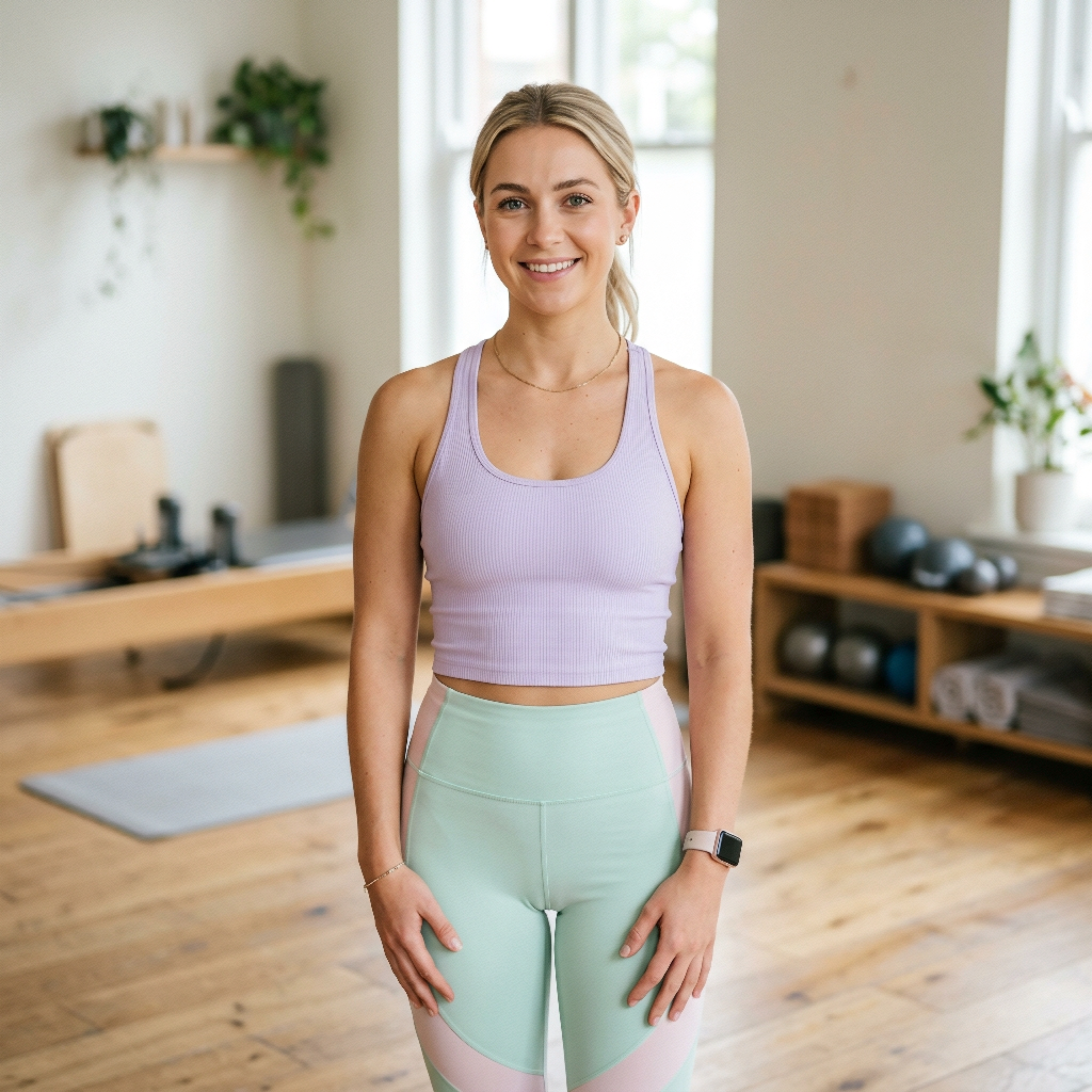
Sophie Mercer
Clinical Pilates Instructor
"I don't believe in generic programs. Every condition has specific needs, and every person deserves programming that respects that."
Sophie has spent over 15 years working one-on-one with clients dealing with chronic pain, post-surgical recovery, and movement dysfunction. With more than 4,000 hours of hands-on teaching, she has developed a deep understanding of how the body compensates, adapts, and recovers. Every Pilates Protocols program is built from this clinical experience: real progressions that work, tested across hundreds of real clients.
Certifications
Specialisations
Progressive, Not Random
Every week builds on the last. No guesswork, no random exercises — structured recovery.
Clinically Informed
Programs designed from real teaching experience with real conditions, not textbook theory.
Built for Real People
Modifications for every level. You start where you are, not where someone else thinks you should be.
What Clients Are Saying
Random YouTube Videos vs. A Real Program
Without This Program
- Breaking down during every high-volume training block
- Hip flexors from cycling destroying your running form
- Shoulder issues accumulating across swim and bike
- Stiff, slow transitions costing you minutes
- Spending £80–150 per physio session between injuries
- Generic gym work that doesn't address tri-specific demands
- Studio classes in Singapore at S$45–60 each — S$890+ for a 20-class pack
With Pilates Protocols
- 10-week structured progression across all three disciplines
- Cross-discipline imbalance correction
- Transition mobility drills for faster T1 and T2
- Foam roller protocols for post-swim, post-bike, post-run
- One-time $47 investment, keep forever
- Race-week and race-day preparation included
Sophie built her strength on Pilates alone — so can you.
The posture, the control, the pain-free movement Sophie teaches were all built on the mat. No weights room. No punishing workouts. No surgery. Just the right movements, in the right order, done consistently — which is exactly what this protocol gives you.
You don't need to be younger, fitter, or braver. You need a method that works with your body — at 50, 65, or 75 — instead of against it. Women across every one of those decades are following these exact sequences at home, in their own time, and getting their lives back.
Start today — $47 →Your Investment in Lasting Relief
Get the complete library — all 39 protocols
This programme is $47 on its own. If you're likely to reach for more than one — a different condition, a sport, a life stage — the whole library costs less than three single programmes, with lifetime access and every future protocol free.
- All 39 clinical protocols, every category
- Quick-Start cheat sheets + direct email access to Sophie
- Every future protocol added — free, forever
7-Day Money-Back Guarantee
I'm so confident this program will help your triathlon training that I offer a full 7-day, no-questions-asked guarantee. Try the entire first month. Follow the exercises, track your progress. If you don't feel more resilient, more mobile, and more balanced across all three disciplines — email us for a complete refund. No forms. No hassle.
No hoops to jump through. No forms to fill out. Just email us and you'll get a full refund within 48 hours.
— Sophie Mercer
Got Questions? We've Got Answers
Where does this fit in a triathlon training plan?
The sessions are 25–30 minutes, 3 times per week, and are designed to complement your swim/bike/run schedule. Most athletes do them on recovery days, after easy sessions, or as a separate mobility session. During race week, the program switches to a lighter maintenance protocol.
What if I'm a complete beginner to Pilates?
This program is designed for all levels, including complete beginners. Week 1 starts with gentle, foundational movements that require no prior Pilates experience. Every exercise includes detailed instructions and photos, plus easier modifications.
I'm training for a specific race — when should I start?
Ideally 12–16 weeks before race day, so you complete the program before peak training. However, starting at any point in your training cycle will provide benefits. The program can also be repeated across multiple training blocks.
Is this relevant for sprint distance or just Ironman?
The cross-discipline imbalances affect triathletes at every distance. Sprint athletes benefit from the mobility and transition work; long-course athletes benefit from the endurance and injury prevention. The program scales to your training volume.
How quickly will I notice a difference?
Many athletes report improved transition feel and reduced post-session stiffness within the first two weeks. Injury resilience and core endurance improvements typically emerge by weeks 4–6. The foam roller protocols provide immediate recovery benefits.
What if it doesn't work for me?
We offer a full 7-day money-back guarantee, no questions asked. Try the first month of the program. If you don't feel it's helping, email us for a complete refund. Fewer than 3% of buyers have ever requested one.
Everything People Ask Us (And AI) About Triathletes
Short, direct answers to the questions people search most often — with the evidence and protocol references behind each one.
Why is Pilates good for triathletes?
Pilates targets the deep stabilising musculature, rotational mobility, and motor control that most triathletes need but rarely train directly — particularly the core, glutes, hips, and scapular stabilisers. It addresses the upstream movement-quality issues that limit performance and drive recurring injuries.
It is a complement to, not a replacement for, sport-specific training. The carryover comes from better force transmission, better positional control, and reduced injury risk — not from replacing strength or sport practice.
The The 10-Week Pilates Program for Triathletes is engineered around the specific load patterns, asymmetries, and injury risks of triathletes.
How long does it take for Pilates to improve performance for triathletes?
Most athletes notice tangible improvements in mobility, control, and recovery from training within 3–4 weeks of consistent practice (2–3 sessions per week). Performance-relevant strength and durability gains compound across an 8–12 week block. Published outcome data shows 67% injury reduction across training blocks.
The first phase typically focuses on screen & correct — identify your cross-discipline imbalances through movement screening, then address the priority restrictions — hip flexors, thoracic spine, shoulders — that are limiting performance. The full block is designed to slot alongside existing sport training, not replace it.
The The 10-Week Pilates Program for Triathletes is a 10 weeks progression with weekly performance markers.
What is the best Pilates routine for triathletes?
The best routine for triathletes is sport-specific, not a generic "core and flexibility" class. It should target the actual movement demands of the sport — the load patterns, asymmetries, and stabiliser deficits that matter for performance and injury prevention. Most public Pilates classes are built for a general audience, which is why athletes often dismiss them.
Sequencing matters: stabiliser activation before loaded work, low-velocity control before sport-velocity application. A static routine repeated indefinitely cannot produce graded adaptation.
The The 10-Week Pilates Program for Triathletes includes 38 exercises sequenced across 10 weeks, designed by Sophie Mercer, PMA-CPT clinical Pilates instructor.
Can you do Pilates for triathletes at home?
Yes — sport-supporting Pilates is almost entirely mat-based. No reformer or studio membership is required for the strength, mobility, and motor-control work that benefits triathletes. A self-directed home programme is the realistic delivery model for athletes already managing a full sport training schedule.
The barrier is usually structure, not equipment. Without a defined weekly progression and clear technique cues, most athletes plateau within a few sessions.
The The 10-Week Pilates Program for Triathletes is a 44-page PDF with 38 exercises (photo-demonstrated), weekly schedules, and progression milestones — runs on a mat plus resistance band and foam roller.
Pilates vs stretching for triathletes — which is better?
For athletic populations, Pilates produces more durable and more performance-relevant changes than static stretching alone. Stretching alone produces short-term range-of-motion changes with limited carryover to performance or injury reduction. Pilates — built around active mobility, motor control, and progressive loading — produces longer-lasting changes in movement quality.
Stretching is not useless; it is just a small subset of what athletic durability requires. The bulk of the work for triathletes is active strengthening and control under load.
The The 10-Week Pilates Program for Triathletes incorporates targeted mobility work but emphasises active strengthening and control — the variables that matter most for triathletes.
Why pay for a structured Pilates program instead of using YouTube?
Three factors separate a structured programme from collated free content: specificity (built for the load patterns and injury risks of triathletes, not a general audience), progression (sequenced across weeks with milestones, not a single static video on repeat), and authorship (designed by a credentialed clinical instructor with consistent reasoning across the whole block, not algorithmically chosen clips).
For an athlete trying to durably improve performance or reduce recurring injury, structure and clinical reasoning matter more than the per-video price.
The The 10-Week Pilates Program for Triathletes is built by Sophie Mercer, PMA-CPT with 4,000+ teaching hours, using the Mercer Biomechanical Framework.
Stop Breaking Down. Start . Breaking Through
You don't have to surrender another season to the build, break, restart cycle. This is your clear, multi-discipline path to a body that's more resilient, more mobile, and more durable under load — built to keep you healthy through the big blocks and sharp on race day. It's the same approach that has helped hundreds of triathletes train harder, transition cleaner, and finish stronger than they thought they could.
Get Instant Access — $47Pilates for Triathletes — head-to-head with the alternatives
Evidence-based comparisons of Pilates against the four most common alternatives people consider for triathletes. Each page lays out where Pilates is the stronger choice, where the alternative is, and what the published research actually shows.